
How many times have you cursed when, doing the same test as an Internet user, you type the name of your hotel or guest house and Google brings up paid links to sites other than yours ? This has happened to you often ? And you say to yourself that these links have “diverted” your potential customers to other sites (sometimes business partners) who then charged you commissions ? That's right ? Well, you haven't seen anything yet ! Here is what Google is announcing for the coming weeks …
As we explained in a previous article, OTAs love your “marque” ! Especially when they can divert it to attract customers to their site, take the booking and charge you their commission ! According to specialists on the subject, this practice would bring 15% reservations recorded by OTAs. OTAs are not the only ones to blame, rest assured : there are also their “affiliates”, these sites which rebroadcast their offers (SO, yours) and also advertise with your brand according to their target customers. In this case, the OTA is not responsible for anything.
Your brand as a keyword
Originally, when they buy “advertisement” on Google, the portals that want “divert” your brand define by which keywords a customer will find you. Naturally, the latter may be required to use your brand if the latter is “popular” or if the Internet user has a good chance of coming across it (sur TripAdvisor, on a tourist guide, on the website of your tourist office, etc …).
So far, Google never banned a “advertiser” to use your brand as a keyword…but only as a keyword. The only constraint imposed was that your brand did not appear in the link offered to the Internet user.. Nor in the lines of explanation located under the advertising link. Illustration :
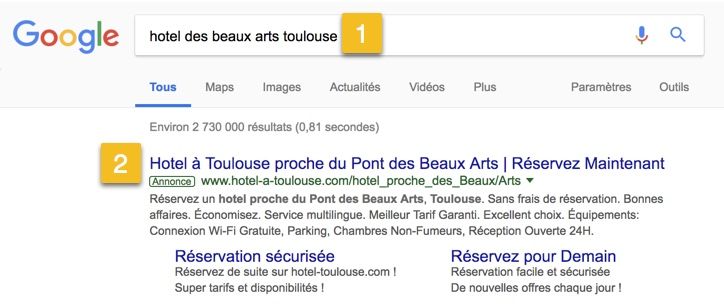
In this example (purely fictional), by typing a combination of keywords (1) including the name of the hotel and the city, the first link (2) which appears is indeed that of the OTA (fictional) which refers to the offer of this hotel … or another, located a few meters.
As seen in the example above, the Internet user types the name of your establishment and that of your city (because he has heard good things about it or seen good reviews on TripAdvisor or Facebook) and decided to look for your site live. The first result(s) displayed are advertising links paid by the OTAs (who broadcast you or not and, in this case, can offer your competitors). The probability that the Internet user does not go any further and clicks on this link is 2 on 3 ! This is how, in most cases, traffic was diverted … and your potential customers.
This practice bears the barbaric name of “Brand Hijacking” or how your brand serves as a keyword to attract your potential customers to sites other than yours (by OTAs but also your competitors). So far, SO, to practice it with complete impunity, it was enough for you “rival” of “stay on track” (do not mention your brand in the link or ad) so as not to attract your wrath or that of Google. Mais, that was before ! From this year, it's going to get really tough for you !
Is your brand still worth anything on the web? ?
This week, Google announced that it was going to break down the last barriers on this point : from now on, it will be possible for an advertiser (or even one of your competitors) to use your brand to “divert” customers of your establishment at home. Comment ? Quite simply by making it appear in your ads and not just by using it as a keyword.

In this example (fictional, him too), the Internet user has typed your hotel brand as a keyword and sees a result which also includes your hotel brand. This practice can be abused by certain portals to divert Internet users to hotels other than yours.. Example : “A cheaper hotel than L’Hôtel des Mouettes in La Rochelle ?..”
This practice is already common among certain OTAs which have received tacit agreement from certain establishments (on the theme of whoever says nothing consents …). Ainsi, it is not uncommon for your establishment (because you have a commercial agreement with this or that OTA) already sees its brand appearing in the latter's advertisements. But the risk, at the bottom, would be that your brand is also hijacked by a competitor. If the latter already communicates using your brand as a trigger keyword for its advertisements on Google, he will now be able to use it with complete impunity in his ads:
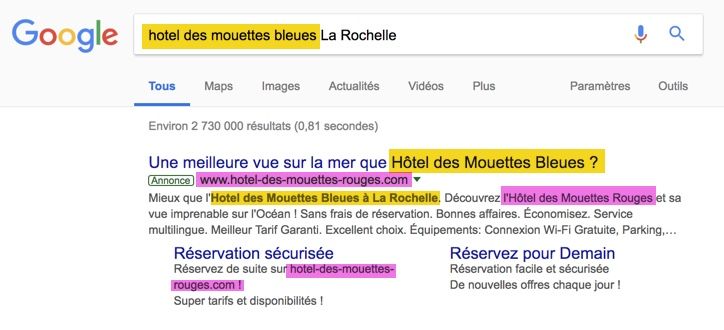
This example (fictional) may seem excessive but it could perfectly apply to a “concurrent” (par exemple, an apartment building) who would declare himself “close to the Hôtel des Mouettes Bleues” but cheaper …”
In a few weeks, Google will therefore open the floodgates and generate waves of new campaigns based on your brands as keywords and, from now on, as a key phrase in links and advertisements. The worst, is that your competitors will have all the rights ! This is already the case in Anglo-Saxon countries (US, UK, Australia, Canada, Ireland and New Zealand) where a distributor, a reseller or the publisher of an informative website has the right to use the brand of its competitor; which was not yet the case in Europe… See Google policy in the matter : to date and before its profound change in the weeks to come.
Since then, for an establishment whose income largely depends on OTAs (who of the value of his business ?) and who will now see his brand misused with complete impunity, what happens to its main assets; the business in the lead ?
What to do in case of overflow ?
You are in a very competitive destination and you fear that your brand will be misused as part of this (r)evolution ? What can you do ?
First of all, make sure your brand really is one ! Is it filed with the INPI (France), of OHIM (Europe) or any other national trademark registration body ? Non ? In this case, to date, you can't do anything ! Your “marque” worthless and its protection is almost zero.
And tomorrow, unless you demonstrate that your brand (if it is registered) has been misused, you will need to send a first “complaint” to Google by filling out this form:
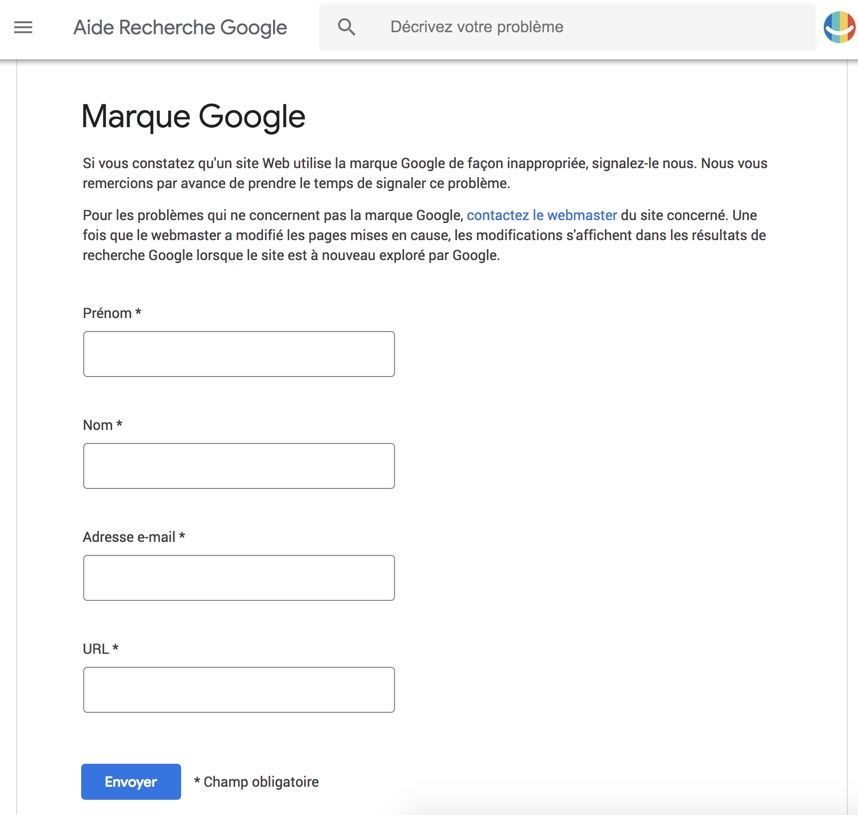
However, do not delude yourself : with the new Google layout, this type of complaint will be even more difficult to succeed than to date … If the problem persists and your brand is seriously compromised, only the intervention of a specialized lawyer (brand on the web, fake review …) will be playable.
Mais, in all cases, in the coming weeks, your complaint can no longer be content with denouncing that “one of my competitors uses my brand in their paid links on Google” … car, the latter will have every right to do so. A real wild west !
Thomas D.
Source: https://blog.elloha.com/2018/10/27/desormais-tout-le-monde-pourra-utiliser-votre-marque-sur-google